About
JOEL (Free Educational Online Judge, from the Catalan "Jutge Online Educatiu Lliure") is a platform for learning to program, a problem repository, and a platform for running programming contests. It is 100% open source.
It was born as an online judge to support the remote teaching of Programming at the Institut Sabadell during the Covid-19 pandemic, but it is open to all educational institutions and to anyone who wants to learn to program on their own. We collect problems from various programming competitions, as well as hundreds of basic learning problems to teach concepts and to use as exercises in class.JOEL runs on top of JODER (Online Judge Intended for Teaching with Feedback, from the Catalan "Jutge Online Destinat a l'Ensenyament amb Retroacció"), which is a (very divergent) fork of DMOJ, a Canadian open-source competitive online judge, modified to serve an educational purpose.
We ask users to read the participation rules before taking part in the comment system.
What is JOEL?
Online Judge
JOEL is an Online Judge, like Domjudge, aceptaelreto, codeforces, or many others. An Online Judge basically offers you programming problems, you solve them, and it grades them automatically. Then it gives you points depending on the difficulty of the problem.
There's a leaderboard where you can compete with other users or against the students from your school.
Educational
JOEL, unlike other judges, is an educational judge. The problems are generally easier, they are tagged so you know what knowledge you need to solve them, if the program doesn't run correctly it tells you where and why instead of simply telling you that you got it wrong, and it has a hints system where you can ask the system to tell you which case is failing. Each problem has its own comment system where you can talk with other users to discuss the problem or ask for/give hints.
JOEL problems, instead of being scored with a 0 or a 1, also give a partial mark depending on the test cases you've passed, so as not to discourage students who try difficult problems and don't pass every case.
Free
JOEL is a Free system. Not only is the code completely open, but the idea is that anyone, and not just the administrators, can create problems. Any user with a bit of experience who has read the guides can ask for permission to create problems, make new problems, and after a review, see them published on JOEL under their authorship. All the test cases can be seen by a teacher account, since that way they can help students get unstuck on problems, which means the problems are also open source, in contrast to other competitive judges, where test cases are a jealously guarded secret.
What is JOEL NOT?
JOEL is NOT a competitive judge. Although we have competitive problems, we try to make half of our problems simple learning problems.
JOEL is NOT a judge with 100,000 test cases per problem. JOEL problems have about 20-25 test cases, covering the edge cases and the ones most likely to fail, but no more. The hints system and partial marking make the judge slower than a normal judge, so we don't want to overload it
JOEL is NOT a judge that's strict about the Timelimit. Of course we have Timelimit problems, and in almost every problem brute-force solutions will fail, but we won't force problems that can only be solved in C++ nor make users use specific input/output libraries. This may mean that problems with non-optimal solutions get accepted
JOEL is NOT perfect. Anyone can make problems, and in fact many students do, since it's a great activity that really helps to understand how to create test cases and effective testing. Sometimes there will be problems with statements that are hard to understand, or that accept non-optimal solutions. Occasionally a problem could have a serious mistake. Keep that in mind and be understanding if you find new problems by users who haven't made many. Any mistake in a problem can be reported through the ticket system.
What are hints and superhints?</h4>
When a submission fails, you can ask for a hint: JOEL shows you the exact input of the failing case and what your program answered. If you still can't see it, you can ask for a superhint: an explanation written by JOEL's AI that gets you thinking in the right direction without giving you the solution. There's a limited number per problem. It's explained with screenshots in the student guide.
I don't understand the message the judge returns.
They are all explained on the judge verdicts page .
The judge told me "Internal Error"
That's a problem with the judge and not with you or your submission. An email is sent automatically to the developers when this happens, so there's no need to report it.
Until it's fixed, don't make more submissions because they will keep failing. You can check the status of the judges and the AI server at Status.
The problems are in a strange satanic language
Most problems are made by teachers from Catalan schools and are therefore in Catalan. If you want, you can send me an email and I'll give you permission to create translations. Problems with a translation are automatically shown in the language you've chosen in the footer.
Something is badly translated!
JOEL is available in Catalan, Spanish, English, German and Simplified Chinese, and some translations were done in a hurry. If you find a wrong one, let us know or make a pull request to the translation files in the repository (for example, locale/ca/LC_MESSAGES/django.po for Catalan).
I'm interested in JOEL. How can my educational institution join?
If you're a teacher, send me an email at malbareda -at- ies-sabadell.cat. We'll create a team to keep your students grouped together and a teacher account with which you'll be able to see your students' submissions
You can read the teacher guide here
Who is behind this and how do I get in touch?
JOEL (and JODER) are developed by Marc, who is the Head of Studies for Vocational Training at the Institut Sabadell. If you like competitive programming, you've probably seen me at some Programa'm or at the 12 UVes.
You can get in touch with me by emailing malbareda -at- ies-sabadell.cat for administrative matters or joder -at- ies-sabadell.cat for technical matters
Where do JOEL and JODER run?
JOEL runs on a personal OVH server along with my Discord bots and other stuff.
JODER can run on as many machines as needed, since it's a scalable system. For years the main judge was Kernel, and there have been judges at the Institut Sabadell and on my home computer (which I shut down when I played World of Warcraft). Currently there are two judges connected to the same server as JOEL. You can see which judges are connected at any moment, and whether the superhints AI server is responding, at Status.
Who is Kernel? Does he accept more fans?
Kernel is my cat. He likes fans but he prefers ham.How can I contribute to JOEL?
Mainly by creating problems. Read the guide to creating problems and get in touch with an administrator to give you permissions.
You can also report or fix bugs. Do it through the GitHub Issues of JOEL and JODER.
If you're from an official institution and want to contribute by hosting a JODER on your own server, contact an administrator
How are points calculated? I added up all my points and I have fewer than I should!
The old system rewarded too much those who spent time "farming" a large number of easy problems, and rewarded too little those who spent time solving more complex problems. We can all agree that a 30-point problem should be worth much more than 15 two-point introductory loop problems, which are there to learn loops and not to rack up points. Besides, the old system forced people who wanted points to come back every year to the new "first year" problems and redo very simple if and loop problems so as not to fall behind in the ranking. The new system aims to strike a balance in the leaderboard between users who solve many problems and users who solve fewer but harder ones
In short, the new points system calculates the weighted sum of the scores of the first 100 submissions on different problems. The score of the i-th problem is weighted by 0.95^i. Formally, where S represents the sorted scores and P a user's base points,
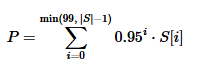
So as not to excessively penalise users who have spent time solving many problems, an additive adjustment B is made to the base points value. Where N is the number of problems for which a user has a fully accepted solution,
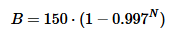
A user's total score is then the sum P+B.
Database problems don't count towards these points: they have their own ranking.