Teacher guide
This guide explains how to use JOEL in class as a teacher: organising groups, following your students' work, seeing where they go wrong and preparing problem lists.
1. Getting teacher permissions
Send an email to malbareda -at- ies-sabadell.cat with:
- a way to prove that you are a teacher,
- the name of your school and a logo (90×40 ratio, it will be the "flag" shown in the rankings),
- which groups you want to create (for example 1r DAM A, 2n ASIX) and whether they should be open (anyone can join) or closed (you have to accept each request),
- your commitment not to use access to test cases and solutions to tamper with any contest.
2. Schools and teams
JOEL has two levels:
- School: the institution. It has a public page with its flag and its list of groups. You will find them under Users → Institutions.
- Team: a specific group (a class, a year, a contest group...). Each team belongs to a school. A student can be in several teams.
If you are a school manager, you can administer all the teams in your school and edit your students' accounts (for example, if someone doesn't remember the email they registered with), but only those from your school.
On the right side of the team page you have all the tools: edit it, view and accept requests, see its members and its statistics.
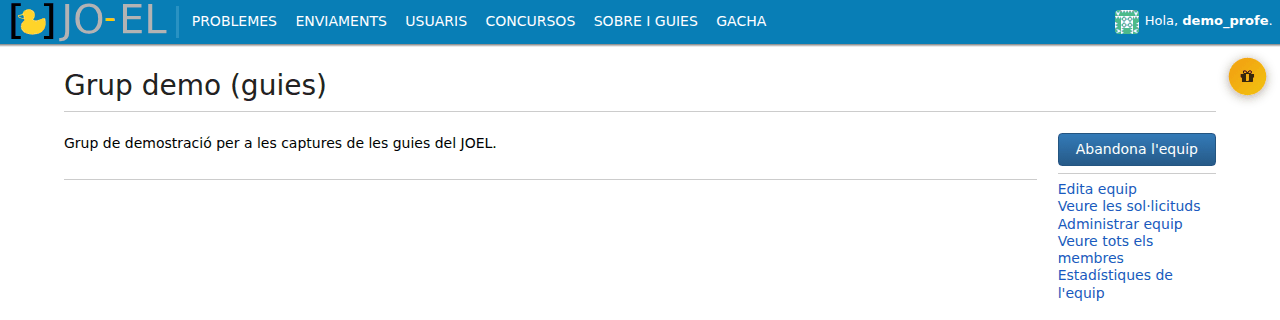
Students join from Edit profile → Affiliated organizations (if it is open) or by requesting it from the team page (if it is closed; you accept or reject the request in View requests).
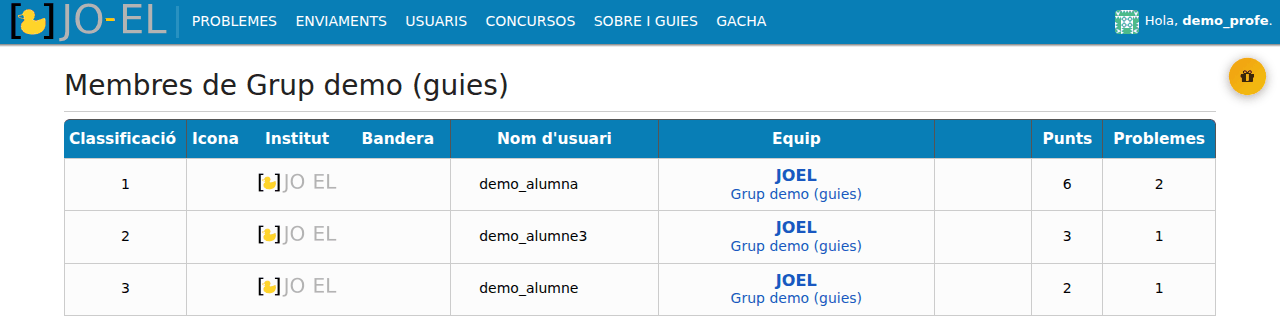
View members gives you a ranking with only your students:
3. Who has done what
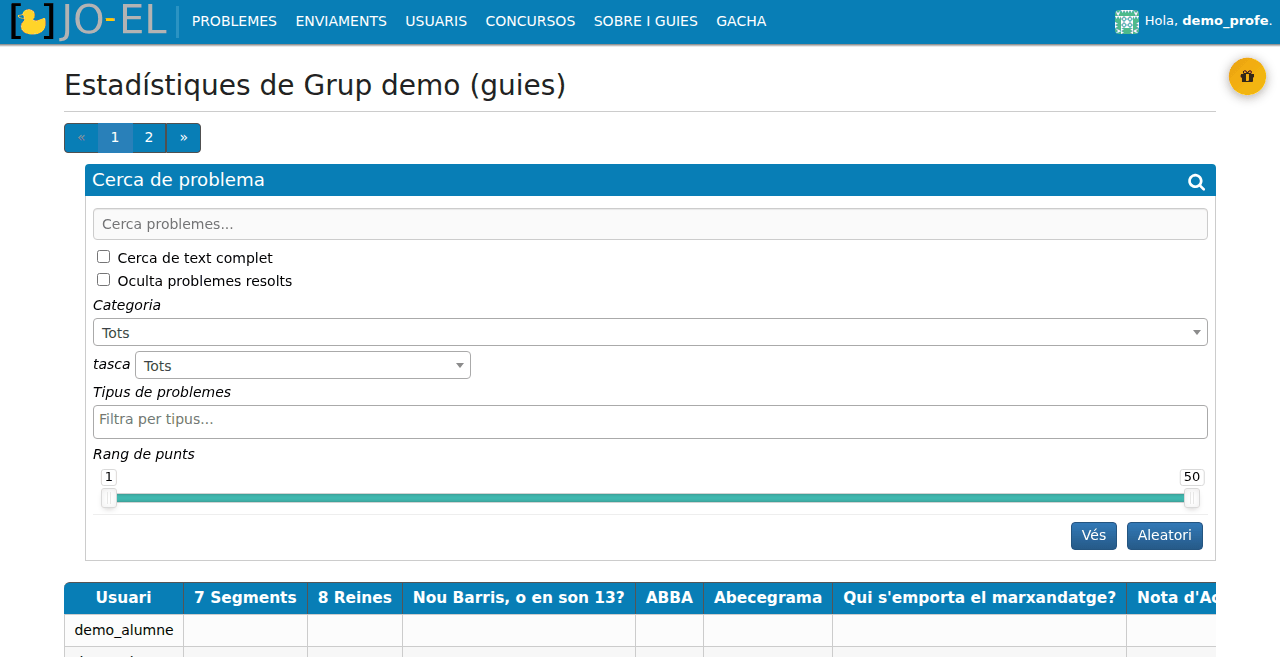
Organization Statistics is a grid with all the team's students and all the problems, with the same search filters as the problem list (category, task, type, points). Green means solved, yellow attempted and white not attempted.
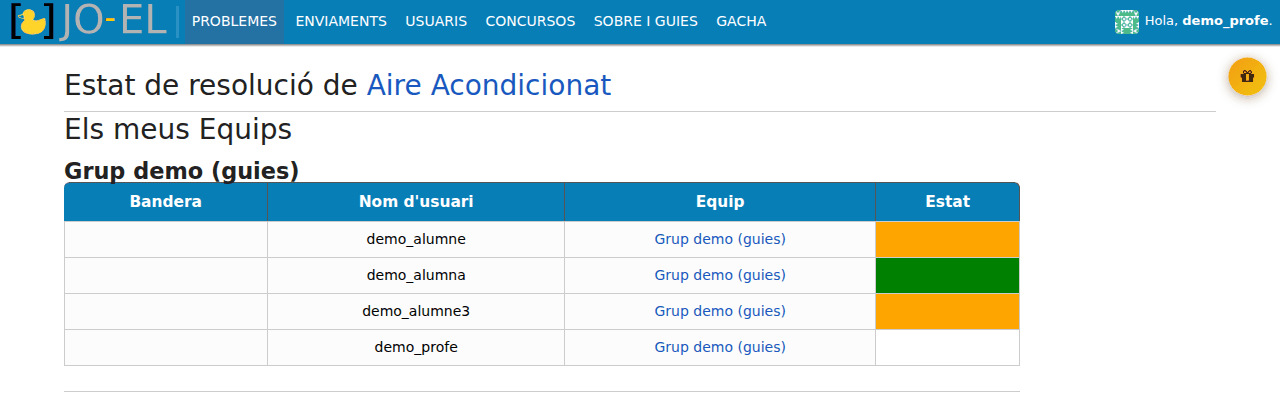
From any problem page, Solve Status shows you the status of each student in your teams on that problem:
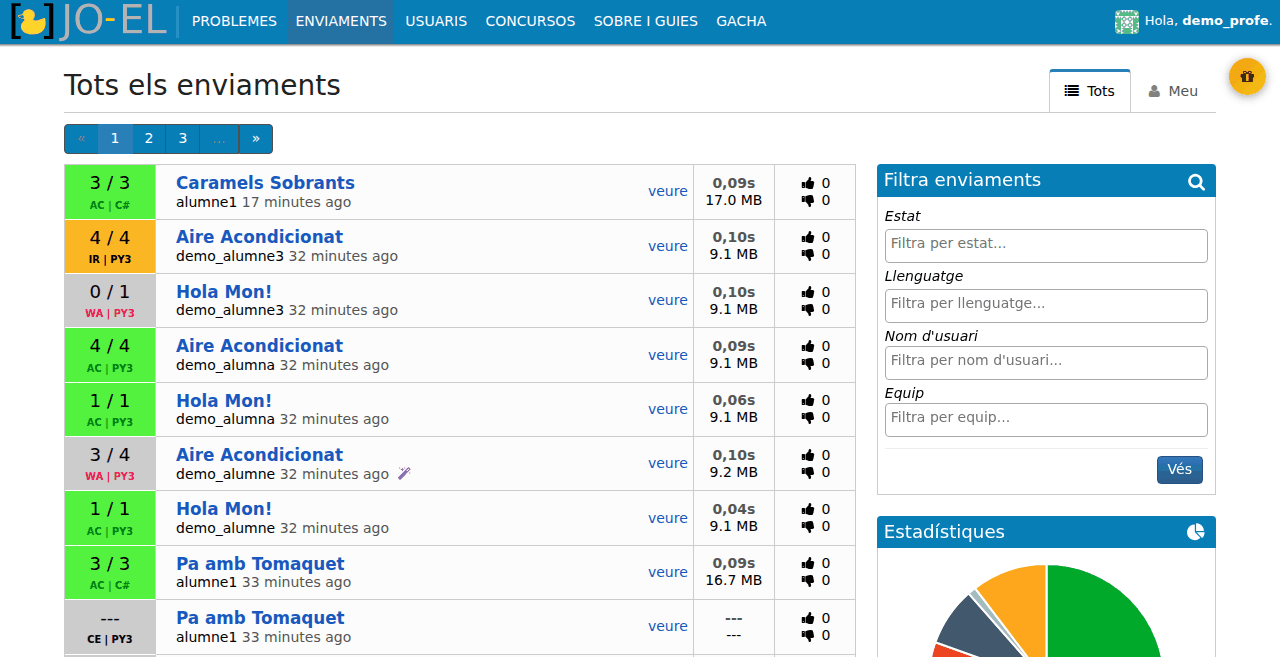
And in Submissions, with the team filter, you see all your students' submissions as they arrive. The magic wand means that a superhint was requested in that submission.
4. Seeing where students go wrong
This is the most useful part for teachers. In a wrong submission, by expanding each test case you see much more information than the student does:
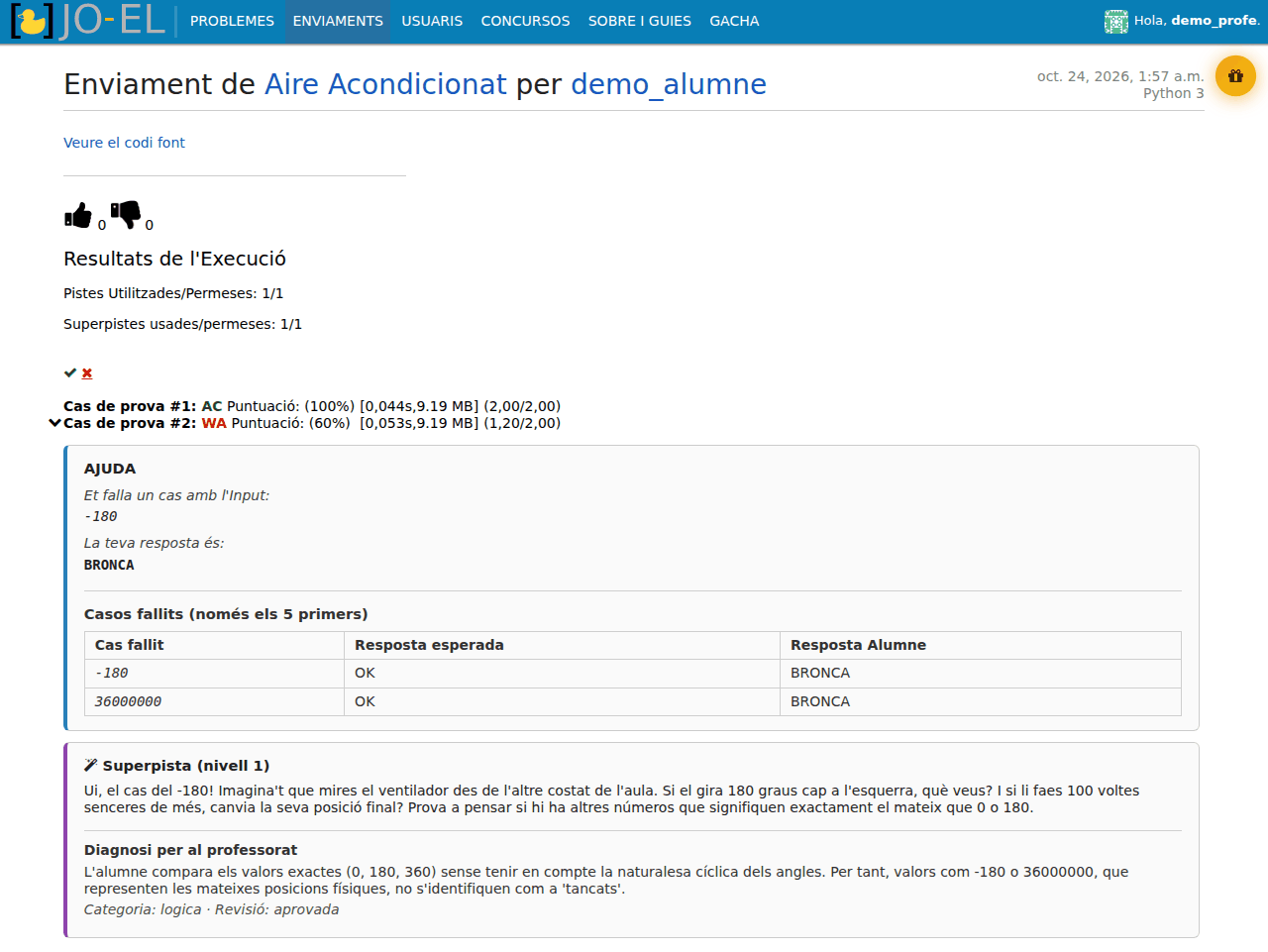
- Help: the hint the student saw (if they asked for it).
- Wrong Answers (only first 5): the input of each failing case, the expected answer and the one the program gave. A ✗ means the program wrote nothing on that line (often because it crashed before).
- Superhint: what the AI told the student and, below it, a diagnosis for teachers with the type of error, which the student doesn't see.
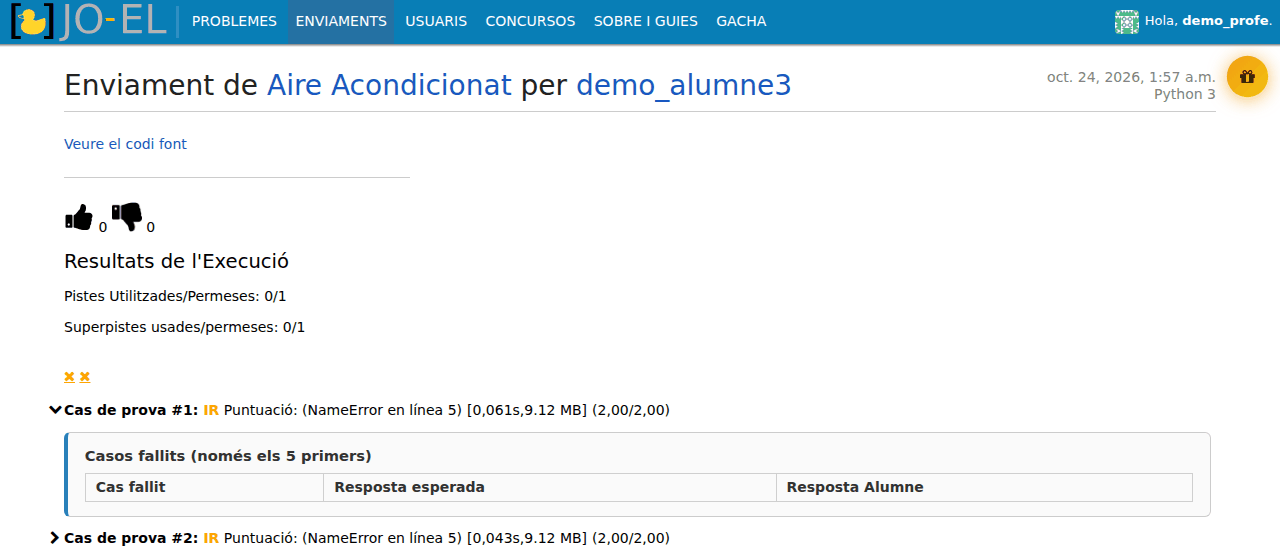
When the program crashes, the verdict (IR or RTE) shows the exception and the line, for example NameError en línia 5:
If the problem doesn't have the hints system enabled, you can still see which line fails and the full input of the case, and work out the information by hand.
5. Tasks
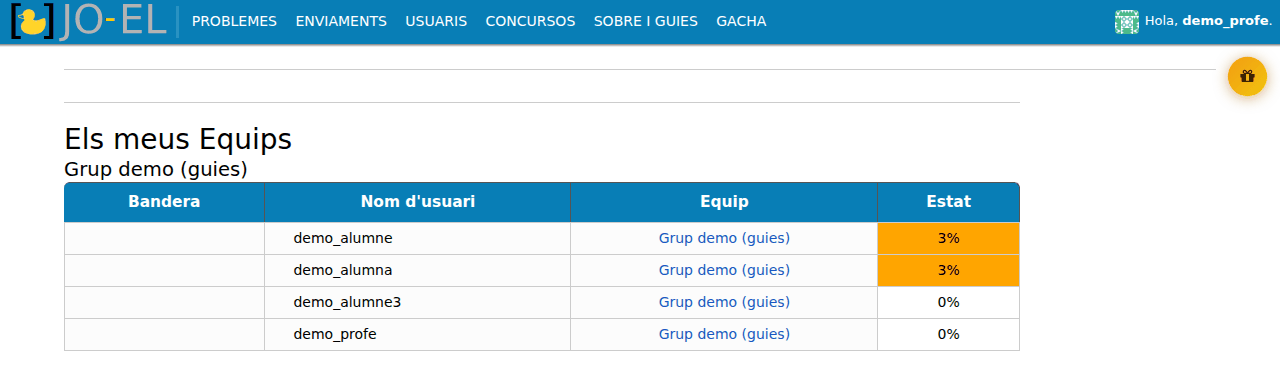
Tasks are ordered lists of problems, for example all those on a topic or those of a practice exam. There are programming and database ones, and anyone can use them. On each task, Solve Status shows you the percentage of the task each student in your teams has completed:
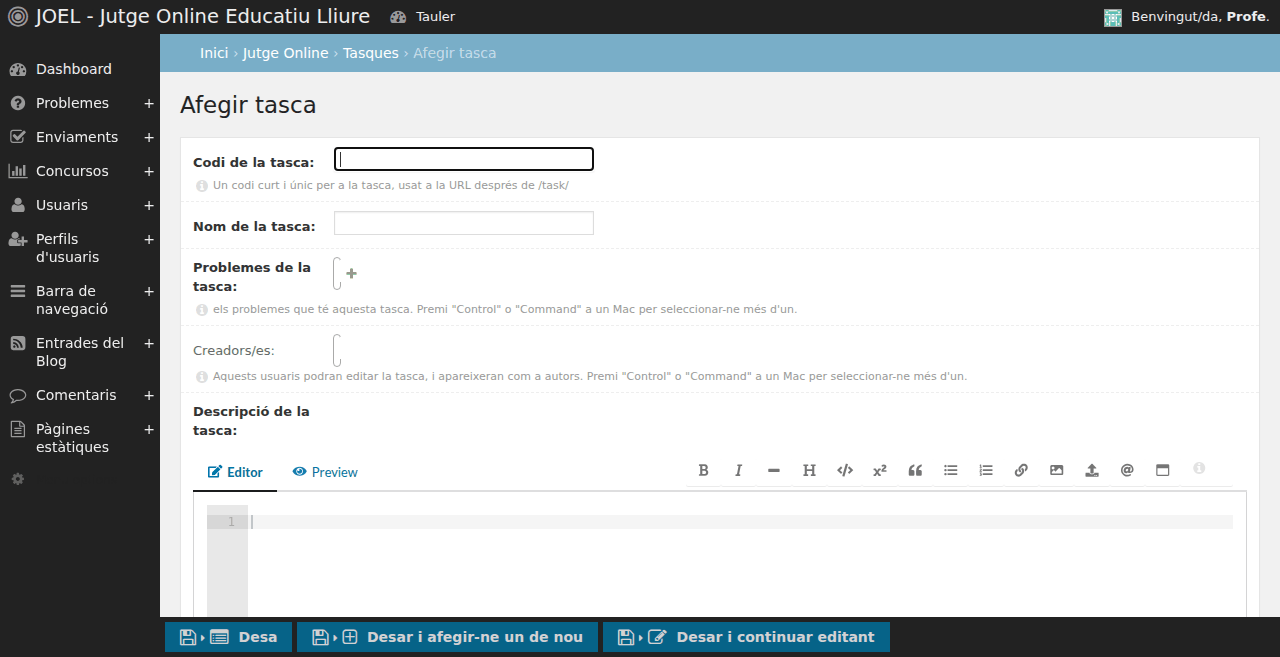
If no task suits you, you can create a new one in the administration (Tasks → Add): you give it a code, a name, a description and choose the problems. You can also clone an existing task from its page and modify the copy.
6. Contests
You can use contests for exams or competitions in class: they have a time limit, their own ranking, scoreboard freezing, and they can also be done "in groups" (students choose a team name). If you want to create them, ask for the contest creator permission.
7. Creating problems
If you want to make your own problems, read the Guide to creating problems and ask for the problem creator permission.